
PDF
Read as a PDF
This article is also available as a PDF with the same content, for printing, saving or sharing.
Download this article as a PDFSection 1
Introduction
Volatile chlorinated organic compounds, typified by trichloroethylene and tetrachloroethylene, are chlorine-bearing organic compounds that readily volatilise into the air at normal temperature and pressure. They are carcinogens, and in Japan too, widespread groundwater contamination by trichloroethylene and similar compounds was revealed in the 1980s by surveys of the then Environment Agency. Groundwater pollution prevention ordinances were enacted in industrial and urban areas across the country, and the Environment Agency (Ministry) responded by amending the Water Pollution Control Act and enacting the Soil Contamination Countermeasures Act.
For volatile chlorinated organic compounds, chloroethylene and 1,2-dichloroethylene were added to the environmental quality standards for groundwater pollution in fiscal 2009, and chloroethylene was added to the environmental quality standards for soil contamination in April 2017. These are substances that can be produced by the breakdown of trichloroethylene and the like.
Section 2
Advantages and challenges of bioremediation
Bioremediation is a technology that breaks down contaminants by drawing on the way microorganisms metabolise organic matter (their food). Because it uses the activity of the microorganisms themselves, it needs far less input energy than conventional remediation such as excavation and removal or thermal treatment.
However, with the technique of activating the microorganisms that already live at the contaminated site (biostimulation), there are concerns about uncertain factors such as effectiveness at the site and the remediation period, because it relies on indigenous microorganisms.
To deal with a wide variety of contaminants, we use multi-microbial agents (microbial consortia).
Section 3
VOC remediation with the multi-microbial agent Oppenheimer Formula™
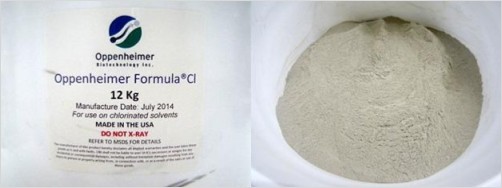
The multi-microbial agent Oppenheimer Formula™ is a consortium of several microorganisms with an outstanding ability to break down oil and VOCs. It was developed by Dr Carl Oppenheimer, professor emeritus at the University of Texas and an authority on marine microbiology, and on the strength of its many results in countries around the world, Japan included, it is listed on the NCP (National Contingency Plan) Product Schedule of the US EPA (Environmental Protection Agency).
Oppenheimer TCE Formula dechlorinates chlorinated organic compounds efficiently and renders them harmless. The hydrocarbons produced by dechlorination through the action of the microbial community become a carbon source for the microorganisms in turn, and are finally broken down into water and carbon dioxide. Because this chain of reactions is carried out continuously by several microorganisms with different degradation characteristics, no harmful intermediate metabolites accumulate during degradation, and remediation without secondary waste is possible.
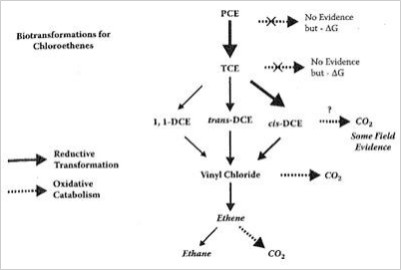
The breakdown of VOCs such as trichloroethylene is widely known through the dechlorination reaction of bacteria of the genus Dehalococcoides (under anaerobic conditions) (Figure 1). Other anaerobic dechlorinating microorganisms, however, are said to have difficulty dechlorinating all the way to ethylene, so there is concern about the accumulation of harmful intermediate metabolites such as vinyl chloride monomer. Trichloroethylene, moreover, often persists under anaerobic conditions, and remediation using aerobic microorganisms has not spread widely.
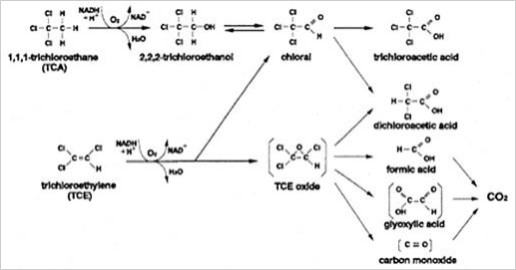
Our experiments so far show that our multi-microbial agent Oppenheimer TCE Formula works differently from the anaerobic reaction and is closer to an oxidation reaction under (micro)aerobic conditions (Figure 2). This article reports the results of a degradation test on simulated trichloroethylene-contaminated water and a field demonstration on actually contaminated groundwater, both using Oppenheimer TCE Formula.
Section 4
Degradation test on simulated trichloroethylene-contaminated water
Test method
- 1. 200 ml of simulated trichloroethylene-contaminated water was placed in each of thirteen 250 ml medium bottles *1
- 2. Two bottles from 1. were sent to a third-party laboratory for initial analysis *2, and one was set aside for the initial measurements *3
- 3. Four bottles from 1. served as controls; the remaining six received measured amounts of nutrient, essential-element solution and the multi-microbial agent Oppenheimer TCE Formula
- 4. The bottles from 3. were incubated on a shaker
- 5. For both series, two bottles each were sent to the third-party laboratory for analysis on days 1 and 7; for the series with the agent, one bottle each was set aside for the measurements on days 1 and 7
*1 Analysis samples n = 2; the same sample was used for the initial measurements
*2 Analysed: trichloroethylene, cis-1,2-dichloroethylene
*3 Measured: total microbial count (direct microscopy / EB fluorescent staining), pH
Test results
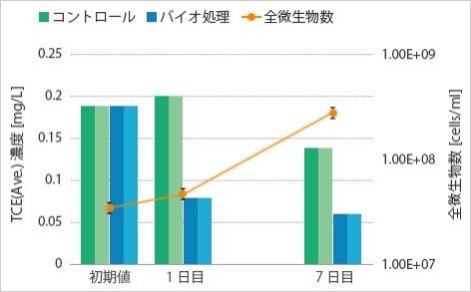
Table 1 shows the analysis results and total microbial counts for each series; Figure 3 shows how trichloroethylene and the microbial count changed. With the addition of Oppenheimer TCE Formula, trichloroethylene fell from an initial mean concentration of 0.19 mg/L to a mean of 0.06 mg/L on day 7.
Table 1: Analysis results and total microbial counts
| Series | Test day | Initial | Day 1 | Day 7 | |
|---|---|---|---|---|---|
| Control | TCE(Ave.) | (mg/L) | 0.19 | 0.2 | 0.14 |
| cis-1,2-DCE(Ave.) | (mg/L) | <0.004 | <0.004 | <0.004 | |
| Total microbial count | (cells/ml) | 3.22E+07 | - | - | |
| Bio-treatment | TCE(Ave.) | (mg/L) | 0.19 | 0.08 | 0.06 |
| cis-1,2-DCE(Ave.) | (mg/L) | <0.004 | <0.004 | <0.004 | |
| Total microbial count | (cells/ml) | 3.22E+07 | 4.69E+07 | 2.65E+08 | |
Section 5
Field demonstration on trichloroethylene-contaminated groundwater at a site in N Prefecture
Outline of the demonstration
This is a case in which groundwater contamination by trichloroethylene discovered at a site in N Prefecture was remediated with a system combining the multi-microbial agent with a unit (bioreactor) that brings out the full degradation capacity of the microorganisms.
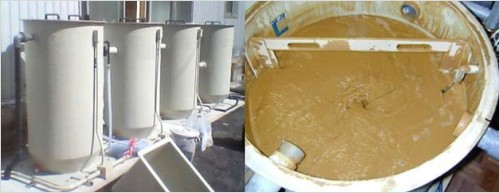
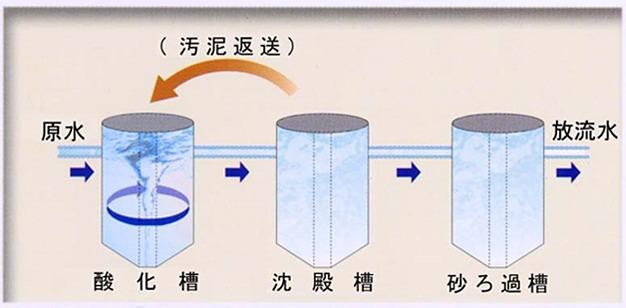
Results of the demonstration
Table 2 shows the analysis results before and after treatment for the volatile organic compounds covered by the groundwater environmental quality standards. Every substance fell below the effluent standard.
Table 2: Reactor treatment results for trichloroethylene-contaminated groundwater
| Item | Raw water | Treated water |
|---|---|---|
| Trichloroethylene | 400 | 0.17 |
| 1,1,1-Trichloroethane | 9.9 | 0.0026 |
| 1,1,2-Trichloroethane | 0.17 | 0.0017 |
| 1,1-Dichloroethylene | 0.3 | <0.001 |
| cis-1,2-Dichloroethylene | 130 | 0.15 |
| Dichloromethane | 14 | <0.001 |
| 1,2-Dichloroethane | 0.62 | 0.0039 |
| 1,3-Dichloropropane | <0.0002 | <0.0002 |
| Tetrachloroethylene | 1.2 | <0.0005 |
| Carbon tetrachloride | <0.0001 | <0.0001 |
| Benzene | 0.36 | <0.001 |
Section 6
In closing
Soil and groundwater contamination by trichloroethylene and similar compounds will continue to be found on industrial land, and former industrial land, used by dry cleaners and manufacturers. At factories still in operation, and at industrial sites with little time left before closure, taking in-situ measures such as bioremediation early can be expected to lower remediation costs. This article has described the remediation of VOC-contaminated soil and groundwater using bioaugmentation, our speciality. Of course, we do not believe the augmentation we recommend is the whole answer. To establish more efficient remediation methods using multi-microbial agents, we will keep working steadily on hybrids with various methods and additives and on the development of new products.
References
- 1. Ministry of the Environment website (https://www.env.go.jp/)
- 2. Jeffrey W. Talley, Bioremediation of Recalcitrant Compounds.
- 3. Hashimoto, A., K. Iwasaki, N. Nakasugi, M. Nakajima and O. Yagi (2002) Degradation pathways of trichloroethylene and1,1,1-trichloroethane by Mycobacterium sp. TA27.
See also
Related pages
Treatment Methods
Soil and groundwater remediation methods
Six remediation methods and how to choose by site conditions.
Testing & Monitoring
Testing and monitoring
From the treatability test to monitoring through completion.
Achievements
Track record
Remediation projects across all 47 prefectures and overseas.