
Aquarium Water Conditioner
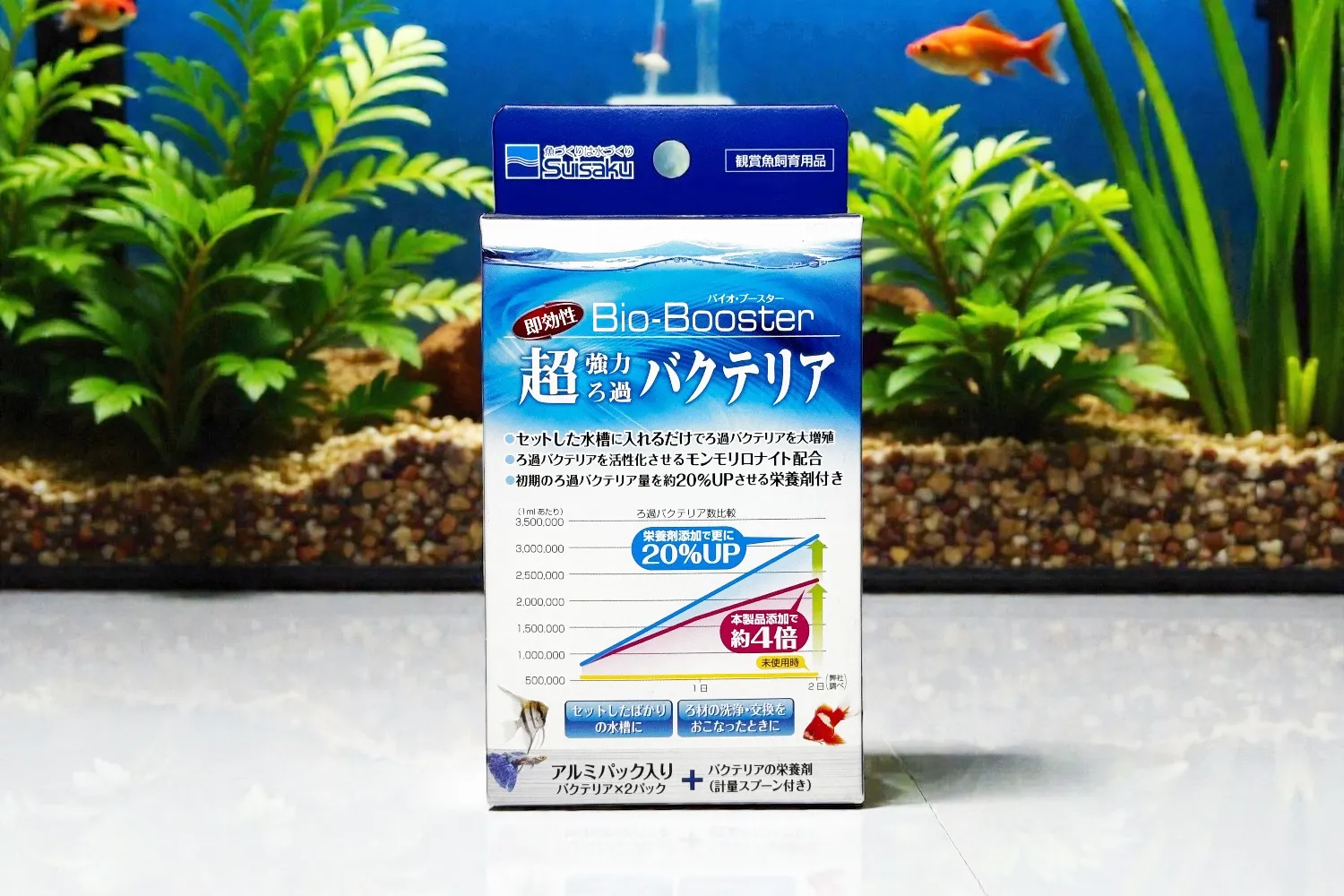
Use as a Water Conditioner for Ornamental Fish
The microbes (bacteria) in the Oppenheimer Formula are a consortium of mixed microbes collected from the natural environment. Their safety has been confirmed through a wide range of safety tests, so they can be used in an aquarium with confidence. The product is also used as a water conditioner (bacterial agent) for ornamental fish. The high concentration of microbes it contains breaks down harmful substances and nitrogen compounds, keeping the aquarium beautiful while providing a safe environment for ornamental fish.
Toxicity Tests on Aquatic Organisms
Tests of Effects on Aquatic Organisms
The safety of the Oppenheimer Formula has been confirmed through a variety of tests conducted by third-party institutions.
Effect on the survival of blue-green chromis (7-day short-term rearing test: acute toxicity test) *1)
Conducted by: The Research Society for Bioremediation of Marine Oil Pollution from the Nakhodka
For each group, 10 blue-green chromis (average body length about 3 cm, body weight about 1 g) were reared and observed for 7 days in 20 liters of artificial seawater at 28°C, fed 3 times per day (morning, noon, evening). The rearing water of the test group was dosed with the microbial preparation to a concentration of 0.1%. (Microbial preparation dosing test)
| Deaths (fish) | Survivors (fish) | Survival rate (%) | |
|---|---|---|---|
| Control group | 0 | 20 | 100 |
| Test group | 0 | 20 | 100 |
The rearing test results showed no acute toxicity to blue-green chromis.
Effect on the survival of rainbow trout (4-day short-term rearing test: acute toxicity test) *2)
Conducted by: Environment Canada
Rainbow trout (average body length about 30 mm, body weight about 0.25 g) were reared for 4 days at 15°C in 10 liters of dechlorinated tap water. The rearing water of the test group was dosed with the microbial preparation to a concentration of 0.1% (10,000 mg/L). (Microbial preparation dosing test). The rearing test results showed that the LC50*3) of the microbes was >10,000 mg/L. From this, no acute toxicity to rainbow trout was found for the microbes.
Reference: The LC50 of a surfactant (LAS, linear alkylbenzene sulfonate; a commonly used surfactant) for rainbow trout = 4.7 mg/L.
Effect on the survival of juvenile ayu (7-day short-term rearing test: acute toxicity test) *1)
Conducted by: The Research Society for Bioremediation of Marine Oil Pollution from the Nakhodka
For each group, 20 juvenile ayu (average body length about 8 cm, body weight about 5 g) were reared and observed for 7 days in 100 liters of fresh water (groundwater) at 19–20°C, fed 3 times per day (morning, noon, evening). The feed of the test group was dosed with the microbial preparation to a concentration of 0.1%. (Microbial preparation administration test)
| Deaths (fish) | Survivors (fish) | Survival rate (%) | |
|---|---|---|---|
| Control group | 0 | 20 | 100 |
| Test group | 0 | 20 | 100 |
The rearing test results showed no acute toxicity to juvenile ayu.
Effect on the survival of juvenile ayu (30-day long-term rearing test: subacute toxicity test) *1)
Conducted by: The Research Society for Bioremediation of Marine Oil Pollution from the Nakhodka
For each group, 20 juvenile ayu (average body length about 8 cm, body weight about 5 g) were reared and observed for 30 days in 80 liters of fresh water (groundwater) at 19–20°C, fed 3 times per day (morning, noon, evening). The feed of the test group was dosed with the microbial preparation to a concentration of 0.1%. (Microbial preparation administration test)
| Deaths (fish) | Survivors (fish) | Survival rate (%) | |
|---|---|---|---|
| Control group | 5 | 15 | 75 |
| Test group | 4 | 16 | 80 |
In the rearing test results, ayu deaths occurred in both the control and test groups, but the number of deaths was lower in the test group, and dissection of the dead ayu revealed no abnormalities whatsoever. Because the ayu deaths were concentrated in the first week after the test began, the cause of death is thought to be shock death due to the change in the rearing environment. Therefore, the microbial preparation is judged to show no subacute toxicity to juvenile ayu.
Effect on the survival of water fleas (2-day short-term rearing test: acute toxicity test) *2)
Conducted by: Environment Canada
Water fleas were reared for 2 days at 20°C in 200 milliliters of dechlorinated tap water. The rearing water of the test group was dosed with the microbial preparation to a concentration of 0.1% (10,000 mg/L). (Microbial preparation dosing test). The rearing test results showed that the LC50*3) of the microbes was >10,000 mg/L. From this, no acute toxicity to water fleas was found for the microbes.
Developmental test on sea urchins (Toxopneusts pileolus)
Conducted by: The Research Society for Bioremediation of Marine Oil Pollution from the Nakhodka
To confirm the effect of the microbial preparation on organisms, a fertilization experiment was performed using sea urchin eggs (trumpet sea urchin, Toxopneusts pileolus). Such fertilization experiments are used in seawater bioassay methods by Environment Canada and the United States Environmental Protection Agency. For comparison, experiments were also conducted using an oil-treatment agent and a household neutral detergent.
The microbial preparation, the oil-treatment agent, and the household neutral detergent were added to seawater at 0 ppm (control), 1 ppm, 5 ppm, 10 ppm, 50 ppm, and 100 ppm. Fertilization experiments were carried out in these solutions, the formation of fertilization membranes on 100 eggs was observed and counted under a microscope, and the average of four repetitions was taken as the sea urchin egg fertilization rate data.
| Concentration (ppm) | Control | Microbial preparation | Oil-treatment agent | Household neutral detergent |
|---|---|---|---|---|
| 0 | 95% | |||
| 1 | 96% | 78% | 82% | |
| 5 | 92% | 61% | 20% | |
| 10 | 92% | 41% | 6% | |
| 50 | 80% | 13% | 1% | |
| 100 | 68% | 4% | 0% |
The experiment showed that, for the microbial preparation, the oil-treatment agent, and the household neutral detergent alike, the sea urchin egg fertilization rate declined as the concentration in seawater increased. However, the degree of effect differed greatly: at 100 ppm, the oil-treatment agent (4%) and the household neutral detergent (0%) markedly inhibited fertilization, whereas the microbial preparation had a small effect at 68%. Therefore, compared with the oil-treatment agent and the household neutral detergent, the microbial preparation is judged to have a small effect.
Citation: Bioremediation on the shore after an oil spill from the Nakhodka in the Sea of Japan, II. Toxicity of a bioremediation agent with microbiological cultures in aquatic organisms, Marine Pollution Bulletin 40 308-324(2000)
Acute toxicity test on mysid shrimp and inland silverside
Conducted by: United States Environmental Protection Agency
In the Mega Borg oil spill incident in the Gulf of Mexico, remediation treatment was performed by bioremediation using the Oppenheimer Formula. Using sample water from this site, a toxicity test of the microbial preparation was conducted on mysid shrimp (Misidopsis bahia) and inland silverside (amenidia beryllina).
The microbial preparation was added at varying concentrations to three sample waters—control, before bioremediation treatment, and after bioremediation treatment—and rearing tests of mysid shrimp and inland silverside were conducted. As a result, in the 96-hour rearing experiment, the LC50 of mysid shrimp and inland silverside was not measured in any system or at any microbial preparation dosing concentration. In this experiment, some deaths of mysid shrimp and inland silverside were observed, but no correlation with the added microbe concentration was found. In addition, the survival of mysid shrimp and inland silverside in the control group was extremely good, confirming that the organisms used in the experiment were in a condition suitable for testing. From the above, no toxicity of the microbial preparation to mysid shrimp or inland silverside was found.
Citation: United States Environmental Protection Agency, Environmental Research Laboratory (July 1990)
Effect evaluation on rotifers (Brachionus plicatilis)
Conducted by: The University of Texas Marine Science Institute
Using rotifers (Brachionus plicatilis) as the test organism, the effect of the microbes (hereafter "the Formula") on rotifers was tested at the University of Texas Marine Science Institute.
Test method:
(1) Test in an axenic system (a state with no other microbes present)
Rotifers were immersed in 0.5% sodium hypochlorite for 3 minutes and, after sterilization treatment, cultured in sterile saline to prepare axenic rotifers. These rotifers were inoculated into sterile seawater (final concentration 5 individuals/ml), to which the Formula (final concentration 0.01 mg/ml) was added. As a control, axenic rotifers (final concentration 5 individuals/ml) were inoculated into non-sterilized seawater. Both the Formula-added and control conditions were tested in quadruplicate. After 4 days of culture, the increase in rotifers (P) and the growth rate (GR) were compared between the Formula-added and control conditions. P and GR were calculated by the following formulas, and the significance of the difference between the dosed and control groups was tested using a statistical program (ANOVA). P = (final concentration − initial concentration) / culture days (4 days) GR = (ln final concentration − ln initial concentration) / culture days (4 days)
(2) Test in an open system (a state with other microbes present)
Rotifers were inoculated into filtered seawater (pore size 1.2 μm), and the Formula (final concentration 0.01 mg/ml) was added. At the same time, a control (no Formula added) was prepared, and after each was cultured for 4 days, the increase in rotifers (P) and the growth rate (GR) were compared between the two, as in the axenic-system test. The test was performed in duplicate, with initial rotifer concentrations of 30 individuals/ml and 17 individuals/ml respectively.
Results:
In both the axenic-system and open-system tests, no significant difference in the increase or growth rate of rotifers was found between the Formula-added group and the control group. Therefore, it was concluded that the Formula has no effect on the growth of rotifers.
Growth-inhibition test on algae (Skeletonema costatum)
Conducted by: Environmental Research and Technology Division, Planning and Coordination Bureau, Environment Agency
A growth-inhibition test of the microbial preparation on algae (Skeletonema costatum) was conducted as follows.
Test method:
Crude oil was added to seawater (crude oil : seawater = 1 : 9), and the microbial preparation was added to each test group at the set concentrations (except for the seawater group and the oil-containing reference group). Algae were then inoculated to an initial concentration of 10,000–20,000 cells/ml, and cultured for 7 days. The algal growth curve (chlorophyll a) is shown below.
Results:
Because the seawater group showed a standard algal growth curve, it was proven that there was no problem with the algae used in the test. No notable difference was found between the algal growth curves of the oil-containing reference group and the preparation-added group. It was proven that the toxicity of this agent when added to oil (crude oil) is equal to or less than that of oil alone. Even at the maximum concentration of the solubility limit, no growth inhibition of the diatom was observed, and the EC50 value, which serves as a toxicity indicator, was above the measurement limit.
Conducted under the Environmental Research and Technology Division, Planning and Coordination Bureau, Environment Agency: Study on Guidelines for the Use of Bioremediation for Coastal Spilled Oil (the Study Committee for Preparing Guidelines on the Use of Bioremediation for Coastal Oil Pollution; the Investigation and Study of Methods for Evaluating the Safety of Environmental Remediation Using Organisms; and the Case-Study Investigation and Study on the Application of Bioremediation to Spilled-Oil Treatment) (FY 1998–2000).
*1) Citation: Bioremediation on the shore after an oil spill from the Nakhodka in the Sea of Japan, II. Toxicity of a bioremediation agent with microbiological cultures in aquatic organisms, Marine Pollution Bulletin 40 308-324 (2000)
*2) Testing institution: BEAK CONSULTANTS LIMITED (Canada, 1993)
*3) LC50: Median Lethal Concentration. The concentration estimated to kill 50% of the test organisms. An indicator of the degree of acute toxicity to aquatic organisms; the lower the value, the higher the toxicity.
Additional Safety Data
Other Safety Data
We have also conducted detailed safety evaluations of the behavior of microbial communities and microbial preparations in bioremediation. The following analysis results are available to view as PDF documents.