
PDF
Read as a PDF
This article is also available as a PDF with the same content, for printing, saving or sharing.
Download this article as a PDFSection 1
"Oil": a composite contaminant
"Oil" includes animal oils, vegetable oils and mineral oils, but "soil and groundwater contamination by oil" generally means contamination by petroleum products consisting mainly of petroleum hydrocarbons (mineral oil).
The main constituents of petroleum are compounds of carbon and hydrogen: it is a "composite (mixture)" of hydrocarbons. The hydrocarbons that make up petroleum range from C1 to C4 (gaseous at room temperature) to C50 and above (from low to high molecular weight), with boiling points spread widely from room temperature to over 700°C, and consist mainly of saturates (paraffins, naphthenes) and aromatics. These are refined at refineries into the various petroleum products (gasoline, kerosene, diesel, heavy fuel oil, lubricating oil and so on), but because they are fractionated and blended in complex ways during refining, their compositions differ.
Gasoline consists mainly of petroleum hydrocarbons in the C4 to C12 range and contains BTEX (benzene, toluene, ethylbenzene, xylene). High-octane (premium) gasoline contains about 24% toluene to raise the octane number.
Kerosene consists mainly of petroleum hydrocarbons in the C8 to C16 range and contains xylene.
Diesel and heavy fuel oil A consist mainly of petroleum hydrocarbons in the C10 to C26 range.
For every petroleum product the chemical identity (chemical formula) is said to be "unspecifiable", because oil is a composite (mixture).
To take remediation measures against "soil and groundwater contamination by oil", one must first know "oil"; without that, no effective remediation is possible.
There are various methods for remediating (treating) oil contamination, as shown in Table 1, but almost all of them except bioremediation require secondary waste treatment. They also need relatively large inputs of energy to install and run plant, or turn the soil and groundwater strongly acidic or alkaline, so their cost and environmental burdens are high.
Bioremediation, by contrast, uses the activity of microorganisms themselves, so it needs little input energy, and because it ultimately breaks the oil down into water and carbon dioxide, no secondary waste treatment is needed; its cost and environmental burdens are low.
Table 1. Methods of remediating (treating) oil contamination (examples)
| Thermal treatment (heating, incineration, etc.) |
| Chemical treatment (hydrogen peroxide, etc.) |
| Lime, ultraviolet light, ozone, etc. |
| Mobilisation and recovery (washing, vapour extraction, pumping, etc.) |
| Excavation and removal (replacement) |
| Solidification and containment |
| Bioremediation |
Section 2
"Multi-microbial" solutions to "composite contamination": a new bioremediation
Bioremediation is a technology that uses the ability of microorganisms to break down contaminants, but whether that ability is made the most of or wasted depends entirely on how the microorganisms are used (the engineering).
Conventional bioremediation activates the microorganisms living at the contaminated site (biostimulation), but it involves many uncertainties: whether microorganisms suited to the contaminant are present, in what numbers, how effective they are at the site, and how they can be controlled. Even methods that culture and introduce large amounts of a microorganism that degrades a specific contaminant find it extremely difficult to deal with "composite contamination" with a single microorganism.
Our technology applies the multi-microbial agent Oppenheimer Formula, which contains at high density a wide variety of microorganisms able to degrade oil, itself a composite (mixture), to the contaminated site (bioaugmentation), and reliably breaks contaminants down into harmless organic matter, ultimately water and carbon dioxide. The agent is a "microbial consortium" collected from natural environments in various regions, and the interaction (teamwork) of the individual microorganisms that make up the consortium makes it possible to degrade a composite (mixture) such as oil and to cope with a wide range of contaminants and environments.
"Multi-microbial" for "composite contamination": soil and groundwater contamination by oil, a composite (mixture), calls for the organic, coordinated work of many kinds of microorganisms.
Section 3
The multi-microbial agent Oppenheimer Formula: effectiveness and safety
Oppenheimer Formula is an oil-degrading multi-microbial agent developed by Dr Carl H. Oppenheimer (professor emeritus, University of Texas), an authority on marine microbiology. It was first used in the world as a marine oil-spill countermeasure in 1990, when crude oil spilled after the explosion of the tanker Mega Borg in the Gulf of Mexico, and it is listed as a microbiological culture on the National Contingency Plan Product Schedule of the US Environmental Protection Agency (EPA). In Japan, beginning with its experimental use during the 1997 Nakhodka heavy-oil spill with the support of Hyogo Prefecture, it has been adopted in a series of publicly funded research and development programmes: the Ministry of the Environment's "Survey on the Development and Dissemination of General-Purpose Groundwater Remediation Equipment" (2001); the Ministry of Economy, Trade and Industry's "Regional Revitalisation Consortium R&D Project (fast-acting type): Development of a Highly Efficient Soil and Groundwater Remediation Technology Using Multi-Microbial Consortia" (2002); and the Ministry of the Environment's "Environmental Technology Verification Model Project: Organic Wastewater Treatment Technology for Small Businesses: Multi-Microbial Tornado-Type Bioreactor System" (verification no. 020-0305) (2003). In 2006 it was also registered in the NETIS (New Technology Information System) of the Ministry of Land, Infrastructure, Transport and Tourism as "Oil remediation technology using a multi-microbial agent" (registration no. KT-060059).
An extensive track record
The agent has been in use overseas for more than 25 years, and in Japan it has been applied in more than 500 soil and groundwater remediation projects over 20 years. Most were at petroleum facilities such as filling stations and oil depots, with contamination by fuel oils such as gasoline, kerosene, diesel and heavy fuel oil containing BTEX (benzene, toluene, ethylbenzene, xylene), but recently there have also been many remediations of contamination by lubricating oils, such as machine oil at ordinary factories, which are considered relatively hard for microorganisms to degrade.
Case: soil contaminated with heavy fuel oil A
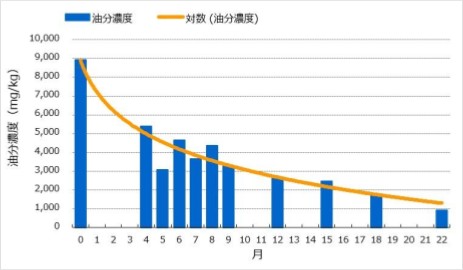
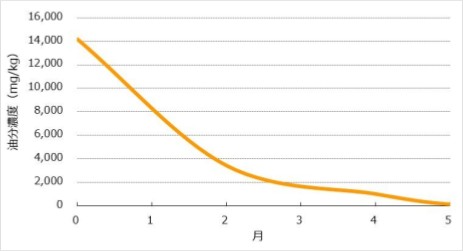
A leak of heavy fuel oil A from the fuel piping of an ordinary factory came to light when an oil film was found on a pond in the adjacent park. About 20,000 m3 of soil was contaminated, and a condition of the remediation work was that the trees in the park were not to be felled. Most of the site was treated in situ (a mixture of multi-microbial agent, nutrient and essential-element solution was injected into the soil and groundwater, combined with bioventing to promote gas exchange in the soil), and the parts that could be excavated were treated by landfarming (the mixture of multi-microbial agent, nutrient and essential-element solution was blended into the soil, stirred and cured). Figures 1 and 2 show the change in oil concentration.
Case: soil contaminated with machine oil
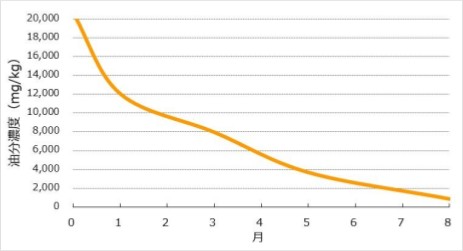
This was machine-oil contamination at a former factory site, with an initial oil concentration averaging about 20,000 mg/kg. Landfarming was used; although snow made stirring impossible in winter, the remediation progressed steadily and reached the target of 1,000 mg/kg in about eight months (December to the following August). Figure 3 shows the change in oil concentration.
Degradation of recalcitrant substances
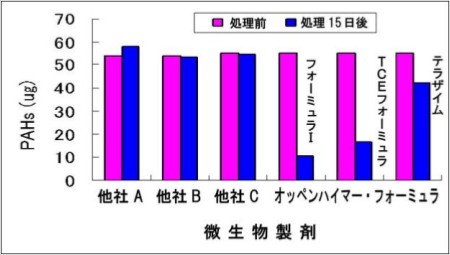
We have demonstrated, from the laboratory to the field, the degradation of substances generally considered recalcitrant, such as heavy oil (including resins and asphaltenes), lubricating oil and polycyclic aromatic hydrocarbons (PAHs). Figure 4 compares the PAH degradation achieved by various microbial agents.
Safety
The agent is a "microbial consortium" collected from natural environments in various regions and contains no genetically modified microorganisms. Quality control confirms the absence of pathogenic microorganisms, and ecosystem safety tests carried out in Japan and abroad, including toxicity tests on aquatic organisms and mutagenicity tests, have confirmed its safety in every case. Beyond "soil and groundwater contamination by oil", the agent is used in a wide range of applications, including wastewater treatment at factories and kitchens, agriculture and aquaculture, and its effectiveness and safety have been confirmed in many settings. Table 2 lists the safety tests performed on the agent.
Table 2. Safety tests performed on the agent
| Test | Result | Source / testing body | |
|---|---|---|---|
| Presence of pathogenic bacteria (microarray analysis) | None | Gifu University Graduate School of Medicine | |
| Presence of pathogenic bacteria (fatty-acid analysis, etc.) | None | Texas Department of Health Accu Lab, Delaware, USA | |
| Presence of E. coli | None | Yagai Kagaku Co., Ltd. | |
| Toxin production test | None | MICROTOX TEST™ (Grace Dearborn Inc., Canada) | |
| ◎ Effects on aquatic organisms | ○ Effects on freshwater and marine fish | ||
| Inland silverside (Menidia beryllina) | None | US Environmental Protection Agency, Environmental Research Laboratory | |
| Rainbow trout | None | Beak Consultants, Canada | |
| Blue-green damselfish (Chromis viridis) | None | Marine Pollution Bulletin, 40 308-324(2000) | |
| Juvenile ayu (Plecoglossus altivelis) short- and long-term rearing tests | None | Same as above | |
| ○ Effects on freshwater and marine invertebrates | |||
| Mysid shrimp (Misidopsis bahia) | None | US Environmental Protection Agency, Environmental Research Laboratory | |
| Rotifer (Brachionus plicatis Muller) | None | University of Texas Marine Science Institute | |
| Water flea (Daphnia magna) | None | Beak Consultants, Canada | |
| Sea urchin (Toxopneustes pileolus) | None | Marine Pollution Bulletin, 40 308-324(2000) | |
| ○ Effects on algae | |||
| Diatom (Skeletonema costatum) | None | Environment Agency study on oil bioremediation | |
| Mutagenicity test | Negative | Saga University Chemicals Evaluation and Research Institute | |
| umu test | Negative | National Institute of Advanced Industrial Science and Technology Chemicals Evaluation and Research Institute | |
| Medaka growth test | Negative | Prefectural University of Kumamoto | |
See also
Related pages
Treatment Methods
Soil and groundwater remediation methods
Six remediation methods and how to choose by site conditions.
Testing & Monitoring
Testing and monitoring
From the treatability test to monitoring through completion.
Achievements
Track record
Remediation projects across all 47 prefectures and overseas.