
PDF
Read as a PDF
This article is also available as a PDF with the same content, for printing, saving or sharing.
Download this article as a PDFSection 1
What is a treatability test?
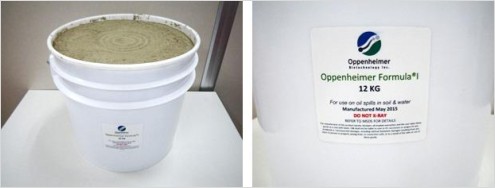
A treatability test (suitability test for biological treatment) is, as the name says, a test that judges whether microbial remediation is suitable. To deal with a wide variety of contaminants we use the multi-microbial bio-agent Oppenheimer Formula™ (a microbial consortium), and we recommend running a treatability test before any soil or groundwater remediation. The test uses soil and groundwater samples taken from the actual site, and shows whether the soil, groundwater or target substance inhibits microbial growth. Because a bio-agent whose effect is already established is used for these checks, the judgement can be made quickly and at low cost (two weeks or more from the start of the test to the report).
Section 2
Test samples
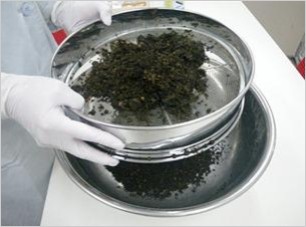
The tests use soil and groundwater taken from the actual site. These vary widely; soils in particular differ not only in nature, clayey or sandy, but also in particle size, and so lack uniformity. Before the test we therefore pass the soil through a sieve of about 4 mm to even out the particle size, adjust the water content, and mix as needed, to keep the sample uniform.
Section 3
Analysis and measurement items (oil-contaminated soil and groundwater)
The analysis item is TPH, the indicator of the target substance (Total Petroleum Hydrocarbons: in general, the quantified petroleum products such as fuel oil and lubricating oil contained in soil or groundwater). The measurement items are total microbial count, pH, nitrogen (ammonia, nitrite and nitrate nitrogen) and phosphorus (phosphate phosphorus), and oil odour and oil film.
TPH can be analysed by GC-FID (gas chromatography with a flame ionisation detector), by IR (infrared spectroscopy), or by n-hexane extraction (gravimetry). We mainly commission GC-FID analysis from a third-party laboratory. The total microbial count is a direct count by direct microscopy; it is free of culture-medium bias and is the method best suited to observing microorganisms in the natural environment. pH, nitrogen (ammonia, nitrite and nitrate nitrogen) and phosphorus (phosphate phosphorus) are measured with simple kits such as pack tests. Oil odour and oil film are quantified in accordance with the Oil Contamination Countermeasure Guidelines (the petri-dish method for oil film).
Section 4
Case examples
Here we present treatability tests on soil contaminated with heavy fuel oil A and on groundwater contaminated with lubricating oil.
Treatability test on soil contaminated with heavy fuel oil A
Test method
- 1. The soil sample taken on site was passed through a 4 mm sieve and 1 kg was placed in a stainless-steel tray
- 2. 50 g from 1. was sent to a third-party laboratory for pre-treatment TPH analysis *1, and 10 g was set aside for the pre-treatment measurements *2
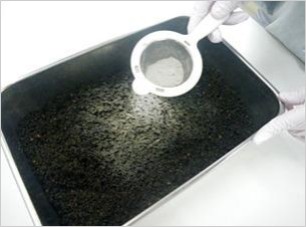
- 3. The specified amounts of nutrient, essential-element solution and multi-microbial bio-agent were added to the remaining soil from 1.
- 4. Mixed once a day and cured at room temperature
- 5. Every two weeks, 50 g was sent to the third-party laboratory for post-treatment TPH analysis and 10 g set aside for the post-treatment measurements
*1 TPH analysed by GC-FID
*2 Measured items: total microbial count (direct microscopy / EB fluorescent staining), pH, nitrogen and phosphorus, oil odour and oil film, etc.
Test results
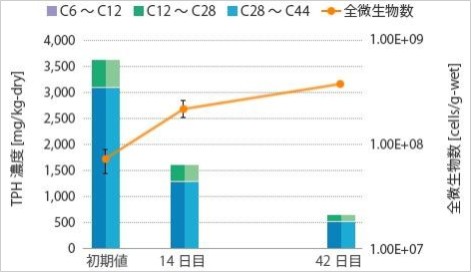
Table 1 shows the TPH results and total microbial counts before and after treatment; Figure 1 shows how TPH and the microbial count changed.
Table 1: TPH and total microbial count (soil)
| Initial | Day 14 | Day 42 | ||
|---|---|---|---|---|
| TPH (mg/kg-dry) | C6~C12 | <48 | <48 | <47 |
| C12~C28 | 520 | 290 | 140 | |
| C28~C44 | 3,100 | 1,300 | 520 | |
| C6~C44 | 3,700 | 1,700 | 650 | |
| Total microbial count (cells/g-wet) | 6.99E+07 | 2.20E+08 | 3.77E+08 | |
Assessment
TPH fell from the initial 3,700 mg/kg before treatment to 650 mg/kg on day 42 after treatment. The total microbial count rose from 6.99E+07 cells/g-wet to 3.77E+08 cells/g-wet, and no growth inhibition was seen. Since the decrease in TPH and the absence of growth inhibition were confirmed, remediation of this soil with the multi-microbial bio-agent is judged feasible.
Treatability test on groundwater contaminated with lubricating oil
Test method
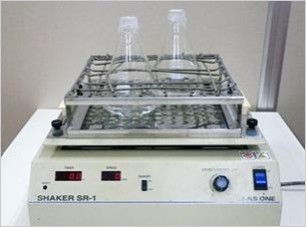
- 1. The groundwater sample taken on site was divided into four 500 ml Erlenmeyer flasks, 100 ml each
- 2. One flask from 1. was sent to a third-party laboratory for pre-treatment TPH analysis *3, and one was set aside for the pre-treatment measurements
- 3. The specified amounts of nutrient, essential-element solution and multi-microbial bio-agent were added to the remaining two flasks from 1.
- 4. The flasks from 3. were incubated on a shaker
- 5. After one week, one flask from 3. was sent to the third-party laboratory for post-treatment TPH analysis and one set aside for the post-treatment measurements
*3 For TPH analysis of water samples (GC-FID), all the oil in the flask was extracted
Test results
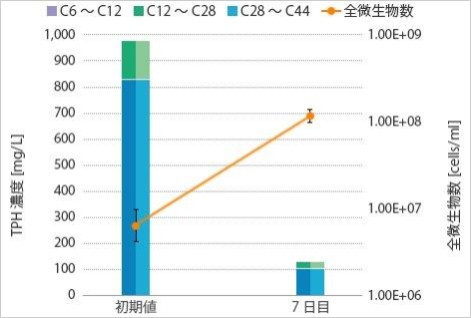
Table 2 shows the TPH results and total microbial counts before and after treatment; Figure 2 shows how TPH and the microbial count changed.
Table 2: TPH and total microbial count (groundwater)
| Initial | Day 7 | ||
|---|---|---|---|
| TPH (mg/L) | C6~C12 | <4.1 | <4.1 |
| C12~C28 | 123 | 24 | |
| C28~C44 | 841 | 100 | |
| C6~C44 | 964 | 124 | |
| Total microbial count (cells/ml) | 6.81E+06 | 1.17E+08 | |
Assessment
TPH fell from the initial 964 mg/L before treatment to 124 mg/L on day 7 after treatment. The total microbial count rose from the initial 6.81E+06 cells/ml to 1.17E+08 cells/ml, and no growth inhibition was seen. Since the decrease in TPH and the absence of growth inhibition were confirmed, remediation of this groundwater with the multi-microbial bio-agent is judged feasible.
Section 5
Evaluation method
For TPH we evaluate the decrease in the total and in each fraction; for the total microbial count, its increase or decrease. For pH we confirm that it stays in the neutral range; for nitrogen (ammonia, nitrite and nitrate nitrogen) and phosphorus (phosphate phosphorus) we check whether the amounts are sufficient for the TPH present. Oil odour and oil film are evaluated qualitatively for the presence of the target substance from the quantified results.
If a decrease in the target substance and an increase in the total microbial count are confirmed in this way, remediation of the sample with the multi-microbial bio-agent can be judged feasible.
Section 6
In closing
Running a treatability test in advance shows whether the soil, groundwater or target substance to be remediated inhibits microbial growth. Confirming the effect beforehand matters greatly, because it means the remediation can be carried out with a high degree of certainty. Although only as a guide, the results of the treatability test can also serve as an indicator for following the progress of the remediation once it is under way.
In addition to the standard treatability test, we also run made-to-order treatability tests to meet customers' requirements. Drawing on our experience, we can set various conditions such as the test period and the analysis items and frequency.
Looking ahead to a soil and groundwater remediation market that is set to grow, we want to promote remediation by bioaugmentation widely. To that end, we first aim to spread the use of treatability tests. Our treatability test has a short verification period and a low cost, and we warmly recommend it.
See also
Related pages
Treatment Methods
Soil and groundwater remediation methods
Six remediation methods and how to choose by site conditions.
Testing & Monitoring
Testing and monitoring
From the treatability test to monitoring through completion.
Achievements
Track record
Remediation projects across all 47 prefectures and overseas.