
PDF
Read as a PDF
This article is also available as a PDF with the same content, for printing, saving or sharing.
Download this article as a PDFSection 1
Oil-contaminated soil in Okinawa
In recent years, as US military bases in Okinawa have been returned, soil contamination by oil and similar substances has come to light and has become a serious problem. Treatment by lime mixing is the mainstream response to oil contamination in Okinawa, but the fact that it alters the properties of the soil has begun to be seen as a problem. Excavation and removal is another option, but in Okinawa the destinations for excavated soil are limited, and shipping it off the island costs an enormous amount. Bioremediation is therefore attracting hopes. Okinawa, however, has soils of its own kind spread widely across the islands, and there is keen interest in how effective bioremediation is on them and whether it can be applied.
Section 2
Bioremediation and multi-microbial consortia
Bioremediation is a technology that uses the ability of microorganisms to break down contaminants.
Our technology applies the multi-microbial agent Oppenheimer Formula™, which contains a wide variety of microorganisms at high density, to the contaminated site (bioaugmentation), and reliably breaks contaminants down into harmless organic matter, ultimately water and carbon dioxide. The agent is a microbial consortium collected from natural environments in various regions, and the interaction (teamwork) of the individual microorganisms that make it up lets it cope with a wide range of contaminants and environments.
Section 3
Bioremediation and lime mixing
Lime mixing is a method in which quicklime is mixed into the contaminated soil and the volatile components are separated and removed by the resulting exothermic reaction. Table 1 compares the characteristics of bioremediation and lime mixing.
Table 1 Comparison of remediation methods for oil-containing soil
| Lime mixing method | Bioremediation | |
|---|---|---|
| Materials | Quicklime | Microbial agent, nutrients, etc. |
| Regulations | "Handling (storing) 500 kg or more of quicklime (calcium oxide content 80% or above) must be reported to the nearest fire station" (Cabinet Order on the Regulation of Hazardous Materials, Art. 1-10) | None in particular. |
| Effects on the human body | When calcium oxide touches the skin or is inhaled, its high reactivity with water causes stinging and inflammation. Inhalation can also cause breathing difficulty. The heat released can cause perforation of the nasal septum, abdominal pain, nausea and vomiting. | None in particular. The microbial consortium has been tested for pathogenicity and toxin production, effects on animals, effects on plants, ecotoxicity by bioassay, dynamics of the microbial community during bioremediation, and the presence of pathogenic bacteria. |
| Equipment | Tent, dust collector, activated-carbon adsorption unit, etc. | None in particular. |
| Advantages | ●Proven track record. ●The treated soil can be compacted reliably, so it is easy to reuse the land for buildings. | ●The soil properties are unchanged, so the land can be reused as farmland. ●Sufficient improvement is obtained even for soil with high oil content, with a proven track record. ●No chemicals spread during the work, so no tent is needed. ●Low environmental load during the work. ●In-situ remediation is possible. |
| Disadvantages | ●The treated soil becomes strongly alkaline, making reuse as farmland difficult. Under strongly alkaline conditions, heavy metals bound to the soil also leach more easily. ●Where groundwater is present, dewatering and slope stabilisation are required. ●Dust control (a tent) is required during the work; if a tent is erected, the typhoon season must be avoided. ●No improvement is obtained for soil with high oil content, and components of high-concentration, high-carbon-number oil (heavy oil) may remain. Such soil is shipped off site for treatment as cement raw material. | ●The remediation relies on the action of microorganisms, so the rate of degradation varies with concentration, soil type, temperature and other factors. |
| Assessment | △ | ○ |
Both treatments have advantages and disadvantages, but lime mixing alters the properties of the soil, making reuse as farmland difficult. Dust damage is also a problem, so expectations for bioremediation are rising.
Section 4
Soils unique to Okinawa
The soils of Okinawa differ greatly from those of other prefectures, ranging from alkaline to acidic to clayey. Table 2 below shows the three representative types.
Table 2
| Type | Characteristics | Distribution |
|---|---|---|
| Kunigami maaji | Strongly acidic clayey soil Red to yellow | Mainly in the northern part of Okinawa Island |
| Shimajiri maaji | Clayey soil mixed with alkaline Ryukyu limestone Reddish brown Highly permeable and well drained | Mainly in central and southern Okinawa Island and Miyako Island |
| Jaagaru | Alkaline heavy clay soil Grey to greyish brown Poorly drained but drought-resistant | Mainly in the southern part of Okinawa Island |
Because Okinawan soils are so distinctive, tests on local oil-contaminated soil and an accumulated record of remediation results are needed.
Section 5
Treatability test (suitability test for biological treatment)
We run treatability tests on Okinawan soils. Here we present tests on a highly contaminated soil (Kunigami maaji) and a moderately contaminated soil (Jaagaru).
Test method
- 1. The soil sample was passed through a 5 mm sieve to homogenise it.
- 2. A pre-test (initial) sample was taken from 1., sent to a third-party laboratory for TPH analysis, and the other measurements *1) were made in-house.
- 3. 1 kg of soil from 1. was placed in a stainless-steel tray.
- 4. The essential-element solution and nutrient were dissolved in (dechlorinated) tap water, added to the soil from 3., and mixed well.
- 5. The multi-microbial agent was added and mixed well. For the moderately contaminated soil, a series without additives was also prepared for comparison.
- 6. The soil was stirred once a day and water was replenished as needed (once a day, enough to moisten the surface).
- 7. On each scheduled day the soil condition was observed and a sample was taken for the same analysis and measurements as in 2. This was done on days 7 and 14 for the highly contaminated soil, and on days 14, 28, 42 and 70 for the moderately contaminated soil.
*1 Measured items: total microbial count (direct microscopy / EB fluorescent staining), pH, nitrogen and phosphorus, oil odour and oil film, etc.
Test results (high concentration)
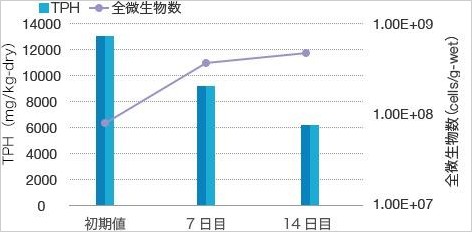
Table 3 shows the TPH concentrations and total microbial counts before and after treatment; Figure 1 shows how they changed.
Table 3
| Initial | Day 7 | Day 14 | ||
|---|---|---|---|---|
| TPH (mg/kg-dry) | C6~C44 | 13000 | 9300 | 6200 |
| C6~C12 | <240 | 85 | 53 | |
| C12~C28 | 13000 | 9100 | 6100 | |
| C28~C44 | <240 | 77 | 49 | |
| Total microbial count (cells/g-wet) | 7.91E+07 | 3.48E+08 | 4.69E+08 | |
Test results (medium concentration)
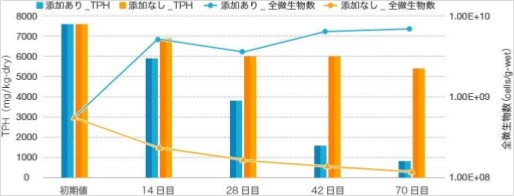
Table 4 shows the TPH concentrations and total microbial counts before and after treatment; Figure 2 shows how they changed.
Table 4
| Initial | Day 14 | Day 28 | Day 42 | Day 70 | |||
|---|---|---|---|---|---|---|---|
| With agent | TPH (mg/kg-dry) | C6~C44 | 7600 | 5900 | 3800 | 1600 | 780 |
| C6~C12 | 360 | 190 | 100 | 100 | 100 | ||
| C12~C28 | 7300 | 5700 | 3700 | 1600 | 760 | ||
| C28~C44 | 100 | 100 | 100 | 100 | 100 | ||
| Total microbial count (cells/g-wet) | 5.81E+08 | 5.17E+09 | 3.53E+09 | 6.37E+09 | 6.51E+09 | ||
| Without agent | TPH (mg/kg-dry) | C6~C44 | 7600 | 6900 | 6000 | 6000 | 5300 |
| C6~C12 | 360 | 100 | 100 | 100 | 100 | ||
| C12~C28 | 7300 | 6800 | 5900 | 6000 | 5200 | ||
| C28~C44 | 100 | 100 | 100 | 100 | 100 | ||
| Total microbial count (cells/g-wet) | 5.81E+08 | 2.39E+08 | 1.69E+08 | 1.36E+08 | 1.16E+08 | ||
Assessment
In both tests a decrease in TPH concentration and an increase in the total microbial count were confirmed. The soils do not inhibit microbial growth, and remediation of the oil in the soil with the multi-microbial agent is fully feasible regardless of soil type or TPH concentration.
See also
Related pages
Treatment Methods
Soil and groundwater remediation methods
Six remediation methods and how to choose by site conditions.
Testing & Monitoring
Testing and monitoring
From the treatability test to monitoring through completion.
Achievements
Track record
Remediation projects across all 47 prefectures and overseas.