
PDF
Read as a PDF
This case study is also available as a PDF with the same content, for printing, saving or sharing.
Download this case study as a PDFOverview
Case Overview
In 1994, waste oil that an industrial-waste contractor accidentally released during a warehouse-expansion project flowed into the adjacent rice fields, and all of the rice died. At the request of the contractor's president, who wished to restore the site to its original condition, we successfully removed the waste oil — a blend of various oils that had soaked into the soil — through remediation using a microbial agent.
- Occurred
- 1994
- Cause
- Accidental waste-oil spill during an industrial-waste contractor's warehouse construction
- Damage
- Flowed into the adjacent rice fields and wiped out the entire rice crop
- Remediation method
- Bioaugmentation (applying, mixing, and watering in a microbial agent)
- Outcome
- The soil regained its colour and weeds grew again
Incident
The Waste-Oil Spill into the Rice Fields
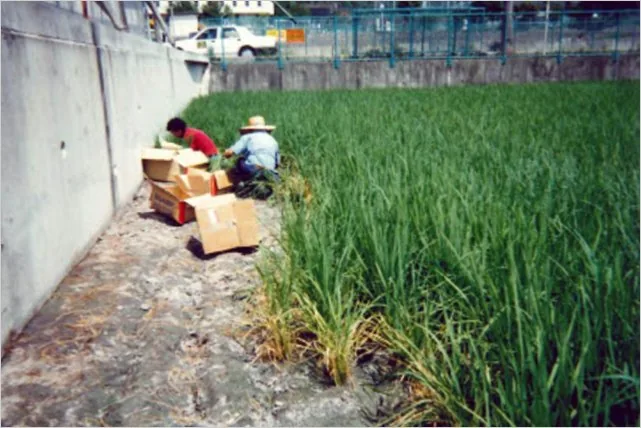
The waste oil flowed into the adjacent rice fields, and all of the rice died. The contractor's president promised the field's owner that he would "provide as much compensation and site restoration as possible," buying up all of the rice that had been due to be harvested that year and the next, and committing to the remediation work.
The photographs show the dead rice being harvested and the soil discoloured black by the waste oil. The waste oil leaked out over the concrete wall on the left.
Decision
Consultation and the Decision to Adopt Remediation
The consultation began with a direct phone call from the industrial-waste contractor's president. He had learned about bioremediation through an acquaintance and believed it to be "a technology that will be needed from now on." Awareness was still low at the time, and there were concerns such as "can it really clean things up?" and "is it safe for the environment?" — but on the premise that "I will buy up all the rice myself, and if it fails we can just dig up the soil and move it," he decided to take on the challenge of this new technology.
We had only just started the business, and the effect on waste oil that was a blend of various oils was an unknown, but with the president's understanding we set about a trial remediation on site right away.
Method
The Bioremediation Work
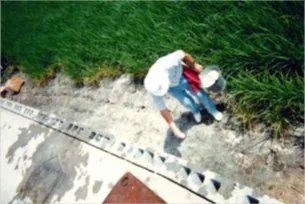
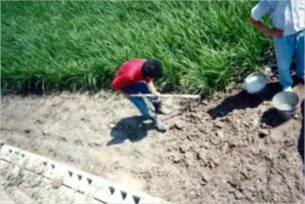
We first harvested the dead rice, then applied the microbial agent by hand to the surface of the black-discoloured soil. The microbial agent is harmless to the environment and to living organisms, and is safe enough to handle with bare hands. Because the waste oil had penetrated not only the surface but also the interior, after application we dug up the soil to thoroughly mix the microbial agent with it, then sprayed water to create an environment in which the microbes could be active. We repeated this "apply → mix → water" cycle once more a week later to make the remediation certain.
Results
The Effect and Outcome of Remediation
Once treatment was complete, the blackened soil gradually regained its original colour, and before long weeds began to grow. If waste oil had remained, neither rice nor weeds would grow. Seeing green return to the rice fields once again, the president was overjoyed.
This achievement was even featured in the newspaper, and for our bioremediation business — which had only just begun at the time — it became a great source of confidence and a turning point.