
PDF
Read as a PDF
This article is also available as a PDF with the same content, for printing, saving or sharing.
Download this article as a PDFSection 1
How groundwater contamination is remediated
Bioremediation is one way of remediating groundwater contaminated by oil. Because it remediates by having microorganisms break down the oil, it has a low environmental load and can also deal with groundwater contamination that has spread over a wide area.
Here we explain the steps from investigating groundwater contamination to remediating the groundwater by bioremediation.
Section 2
Investigating groundwater contamination
When oil contaminates soil, sometimes the contamination stays in the soil, but sometimes the oil seeps deep underground and contaminates the groundwater too. Whether the oil has reached the groundwater can be checked by a boring survey.
Once oil reaches the groundwater it spreads sideways across the water table, and the contamination may extend over a wide area. When the water table rises and falls with the seasons, the oil rises and falls with it, and the contaminated area grows.
To find out whether the groundwater is contaminated, a well is installed, groundwater is sampled, and the oil concentration and oil odour and oil film are checked.
Section 3
Groundwater remediation plan
After the survey, a remediation plan is drawn up on the basis of the survey report.
If bioremediation is adopted, the amount of agent, the injection spacing and the injection method are decided at this planning stage.
We are most often consulted at the stage when this survey report is available. We prepare a quotation based on the survey report.
Section 4
Treatability test
Whether bioremediation can remediate a site depends on conditions that differ from site to site (type of oil, oil concentration, water quality and so on), so you send the oil-contaminated groundwater to us and we run a test to confirm the remediation effect in advance.
The test takes about one to two weeks.
If the treatability test shows that remediation is possible, preparations for the remediation work on site begin.
Section 5
Groundwater remediation methods using bioremediation
Groundwater remediation by bioremediation uses either rod injection or well injection.
Rod injection (direct push)
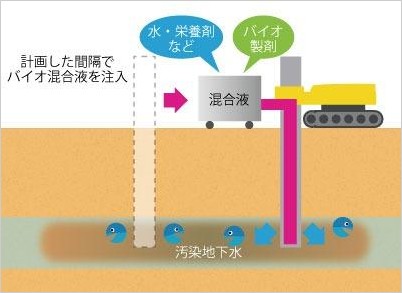
In rod injection, a boring machine drives a rod into the ground, and the bio-mixture is injected at each depth as the rod is withdrawn.
After injection, a pumping well and an injection well can be installed and the groundwater pumped and recirculated to speed up remediation. Oil breaks down faster aerobically, and circulating the groundwater supplies oxygen. It can also be expected to spread the injected bio-mixture evenly.
The groundwater drawn from the pumping well is not only recirculated but also used to monitor the progress of remediation. Monitoring checks TPH, oil odour and oil film, pH, nitrogen and phosphorus concentrations, total microbial count and so on. On site it is also important to check the groundwater level, DO (dissolved oxygen) and ORP (oxidation-reduction potential).
Well injection
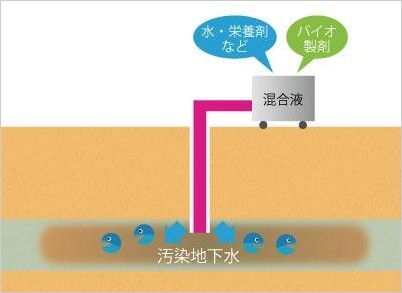
Well injection is a method in which wells of about 50 mm diameter are installed and the bio-mixture is injected through them. There is natural infiltration, in which the mixture is fed in slowly from above under the pressure of the head difference and allowed to seep in naturally, and pressure injection, in which the well is capped and the mixture is forced in under pressure.
In a permeable layer, natural infiltration is also possible.
Once injection is finished, the wells can also be used for pumping and recirculation, as with rod injection. As with rod injection, it is important to monitor the progress of remediation.
Remediation is complete plot by plot as each reaches the remediation target.
See also
Related pages
Treatment Methods
Soil and groundwater remediation methods
Six remediation methods and how to choose by site conditions.
Testing & Monitoring
Testing and monitoring
From the treatability test to monitoring through completion.
Achievements
Track record
Remediation projects across all 47 prefectures and overseas.