
PDF
Read as a PDF
This article is also available as a PDF with the same content, for printing, saving or sharing.
Download this article as a PDFSection 1
How soil contamination is remediated
Bioremediation is one way of remediating soil contaminated by oil. Because it remediates by having microorganisms break down the oil, it has the advantages of a low environmental load and of being able to remediate soil contamination without demolishing buildings.
Here we explain the steps from investigating soil contamination to remediating the soil by bioremediation.
Section 2
Boring survey of soil contamination
Once it is found that oil has leaked into the soil, the extent of the contamination has to be investigated. A boring survey is carried out to find out whether the oil that soaked into the soil has contaminated only the surface layer or has soaked deep down and contaminated the groundwater too, and whether the contamination has spread underground.
In a boring survey, a purpose-built machine drills holes from the surface and collects soil from underground in order to investigate the subsurface geology.
Where to drill and how many holes seem usually to be decided from experience, according to the degree of soil contamination.
Basically the land is divided into 10 m squares (unit plots) and soil is collected at the centre of each plot.
The drilling depth may also be decided with reference to how much oil leaked and, if a boring survey has been done before, the soil type, strata and presence of clay layers found then.
Once the soil has been collected, it is analysed for how much oil it contains, and the extent of the contamination is judged.
Section 3
Soil remediation plan
After the boring survey, a remediation plan is drawn up on the basis of the survey report. The best remediation method is chosen from the soil type, the spread of the oil contamination, the presence of buildings, the budget and the date the land is to be handed over, whether the groundwater is contaminated, and so on.
If bioremediation is adopted, the amount of agent, the injection spacing and the injection method are decided at this planning stage.
We are most often consulted at the stage when this survey report is available. We prepare a quotation based on the survey report.
Section 4
Treatability test
Whether bioremediation can remediate a site depends on conditions that differ from site to site (type of oil, oil concentration, soil type and so on), so you send the oil-contaminated soil to us and we run a test to confirm the remediation effect in advance.
The test takes about one week to one month.
If the treatability test shows that remediation is possible, preparations for remediation on site begin.
Section 5
Soil remediation methods using bioremediation
Soil remediation methods using bioremediation fall into several types according to how the microorganisms are delivered into the soil.
Landfarming
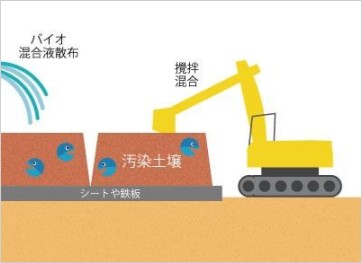
This method is used when the soil contamination is relatively shallow. The contaminated soil is excavated and piled in one place, and the bio-mixture is sprayed on and mixed into the soil.
Because the soil is always within reach, it has the advantage that progress is easy to check: the oil odour and oil film can be checked, and soil can be sampled and sent for analysis to confirm the oil concentration.
What matters in landfarming is to water and stir the soil regularly so that it does not dry out (to keep its moisture). Microorganisms use oxygen dissolved in water and nutrients (nitrogen, phosphorus, potassium) dissolved in water, so if the soil dries out completely, their ability to break down oil declines. Contact between the microorganisms and the oil also matters, and for that, regular stirring is essential.
Of the methods introduced below, landfarming is the one we recommend most. The condition of the soil is easy to check and the soil and microorganisms are easily brought into efficient contact, so remediation proceeds quickly.
However, because the soil has to be excavated, it cannot be used where there are buildings, and space is needed to store the excavated soil temporarily.
In-situ mixing
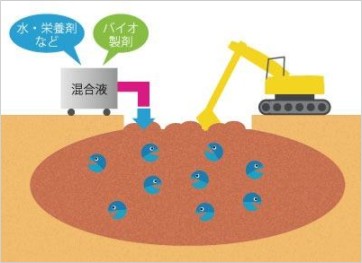
In-situ mixing is a method in which the contaminated soil is not excavated but the bio-mixture is mixed into the soil where it lies, using a backhoe or a column-type soil improvement machine. It is used when the soil contamination is shallow and can be applied down to the depth a backhoe bucket can reach.
Compared with landfarming, there is no need to excavate the contaminated soil and no need to worry about secondary contamination by the oil.
Like landfarming, in-situ mixing cannot deal with soil contamination beneath buildings.
Monitoring in landfarming and in-situ mixing
In landfarming and in-situ mixing, soil is sampled to monitor the progress of remediation. The monitored items are oil concentration (TPH), oil odour and oil film, water content, pH, nitrogen and phosphorus concentrations, total microbial count and so on.
Nitrogen and phosphorus are components the microorganisms need to break down the oil. When the amounts of nitrogen and phosphorus fall short of what is needed for the oil remaining, nutrient is added.
Monitoring is done once every one to two weeks at first, and then about once or twice a month. When the oil concentration reaches the target, the remediation is complete.
Rod injection (direct push)
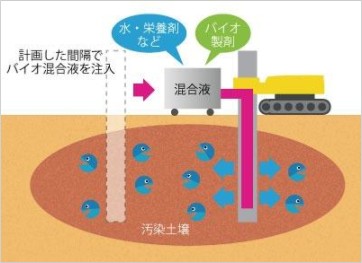
For remediating deep soil that landfarming and in-situ mixing cannot easily reach, rod injection (direct push) is used. It is the most used method after landfarming.
In rod injection, a boring machine drives a rod into the ground, and the bio-mixture is injected at each depth as the rod is withdrawn.
The injection spacing depends on the soil type. In soil with poor water permeability there can be more than 40 injection points per 10 m square.
After injection, bioventing is sometimes carried out to promote degradation. The microorganisms used in bioremediation are aerobic, so they need oxygen. In bioventing, unperforated pipes are inserted at regular intervals into the holes left after injecting the bio-mixture, each pipe is connected to a blower at the surface, and the gas underground is vented, drawing oxygen into the ground. Measuring the vented gas with detector tubes shows the conditions underground.
When bioventing is carried out and the vented gas no longer smells of oil and the gas measurements reach the expected values, boring is done again and soil is sampled. If the oil concentration in the soil is below the target, the remediation is complete.
Well injection
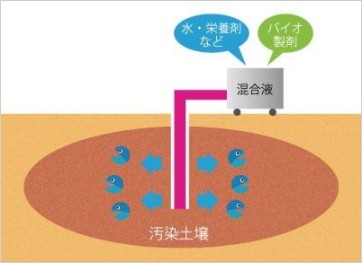
Well injection is a method in which wells of about 50 mm diameter are installed and the bio-mixture is injected through them. There is natural infiltration, in which the mixture is fed in slowly from above under the natural pressure of the head difference and allowed to seep in, and pressure injection, in which the well is capped and the mixture is forced in under pressure.
See also
Related pages
Treatment Methods
Soil and groundwater remediation methods
Six remediation methods and how to choose by site conditions.
Testing & Monitoring
Testing and monitoring
From the treatability test to monitoring through completion.
Achievements
Track record
Remediation projects across all 47 prefectures and overseas.