
PDF
Read as a PDF
This case study is also available as a PDF with the same content, for printing, saving or sharing.
Download this case study as a PDFOverview
Case overview
In January 1997, during Japan's largest-scale marine contamination caused by heavy oil spilled from the Russian tanker Nakhodka, the remediation effectiveness of our bioremediation was demonstrated.
- Occurred
- January 1997
- Contaminant
- Class-C heavy oil (over approx. 6 million L)
- Remediation method
- Bioaugmentation (Terrazyme)
- Outcome
- Heavy oil almost completely gone in about 10 weeks
Background
The accident and the adoption of bioremediation
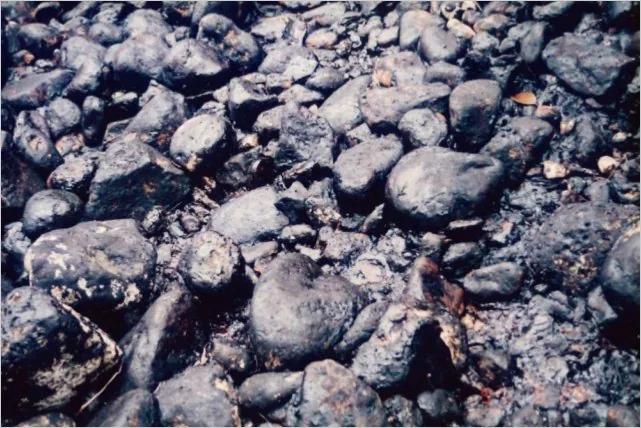
The Nakhodka broke apart in the Sea of Japan, and its bow section drifted ashore at Mikuni-cho, Fukui Prefecture. More than approximately 6 million L of Class-C heavy oil spilled, and because rough weather rendered both the oil-recovery vessels and the oil-treatment agents ineffective, the contamination spread across one metropolitan prefecture and five prefectures, becoming an accident of the worst scale. Immediately after the accident, at the request of Shibayama Port in Hyogo Prefecture, we took on microbial remediation — a method then almost unknown in Japan.
Collaboration
Launch of the study group and collaboration
Together with experts from fisheries cooperatives, universities, fisheries experiment stations, insurance companies, oil companies and others, we established the "Nakhodka Marine Oil Contamination Bioremediation Study Group." In addition to the fishermen's labor-intensive oil recovery, we spread our biological agent "Terrazyme" onto the oil remaining in rock crevices and shallows.
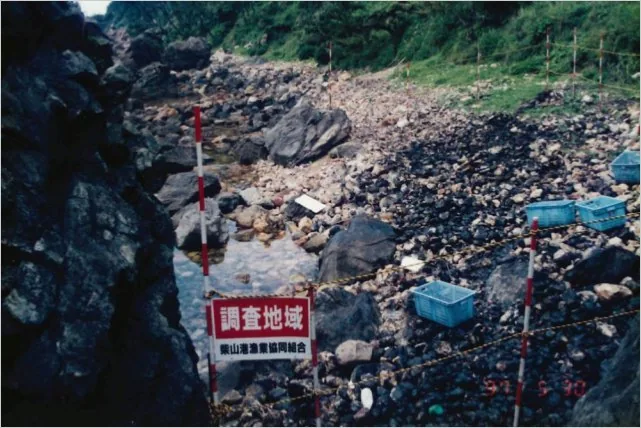
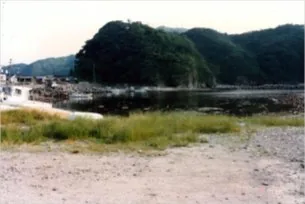
The survey area set by the study group, and a scene of oil recovery in the field
Field trial
Field trial and remediation results
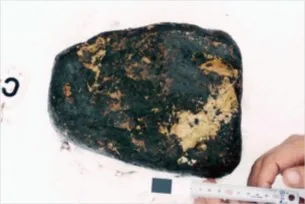
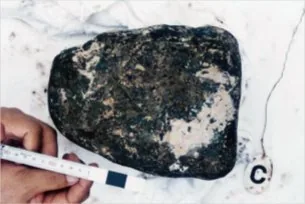
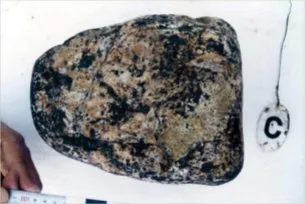
"Terrazyme" is a community of natural microorganisms collected from nature, confirmed by safety testing to have no impact on marine life. When a comparative trial was conducted at the water's edge on heavy oil adhering to rock, the stone surface began to show within 3 weeks, and after about 10 weeks the heavy oil had almost completely disappeared, revealing the natural rock face.
Significance
Significance of the demonstration
Oil drifting on the sea surface can be recovered, but oil that has worked its way into rocky shores and sandy beaches is difficult to remove. This trial demonstrated that bioremediation is also effective against such "oil that cannot be removed by hand." The results were presented at academic conferences in Japan and abroad and compiled into a report titled "Marine Contamination Countermeasures Through Bioremediation."
Related materials
Related materials
- Study group report: "Marine Contamination Countermeasures Through Bioremediation"
- Featured article: Nikkei Biotech No. 372 (published March 24, 1997)