
PDF
Read as a PDF
This article is also available as a PDF with the same content, for printing, saving or sharing.
Download this article as a PDFSection 1
1. Introduction: what are petroleum hydrocarbons?
Contamination of soil and water bodies by petroleum hydrocarbons (PHs) is regarded as a serious problem worldwide. Petroleum hydrocarbons are petroleum-derived substances made of carbon and hydrogen, and can be classified as in Figure 1.
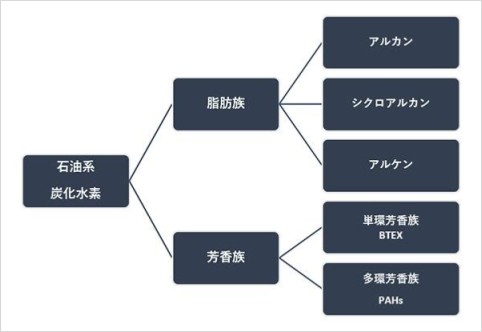
Other countries treat petroleum hydrocarbons as pollutants because of their toxicity, mutagenicity and carcinogenicity, but under Japan's environmental laws the only petroleum hydrocarbon regulated is benzene. Research and specialist literature on "oil contamination" are very scarce in Japan. Here we present what we have learned from overseas literature and from actual projects.
Section 2
2. Effects of petroleum hydrocarbons
Petroleum hydrocarbons can accumulate in the human body through vegetation and the food chain and pose a potential health risk. Total petroleum hydrocarbons (TPHs), made up of hundreds of PHs such as diesel, gasoline and lubricating oil derived from crude-oil fractions, contain substances of high toxicity, mutagenicity and carcinogenicity, and their toxicity increases with molecular weight.(1)
Effects of petroleum hydrocarbons on humans(1)
When humans are exposed to petroleum products or petroleum hydrocarbons, the following health effects are cited.
- Disorders of blood formation, liver, kidneys and lungs
- Changes in cognitive function
- Psychological problems
- Disorders of the reproductive and respiratory systems
- Cancer
Benzene has been identified as a cause of leukaemia in humans. The US EPA (Environmental Protection Agency) also classifies seven PAHs, benzo(a)anthracene, benzo(a)pyrene, benzo(b)fluoranthene, benzo(k)fluoranthene, chrysene, dibenzo(a,h)anthracene and indeno(1,2,3-cd)pyrene, as probable human carcinogens.
Effects of petroleum hydrocarbons on ecosystems(1)
The components that cause contamination are mineral oil, polycyclic aromatic hydrocarbons (PAHs) and volatile aromatic hydrocarbons (BTEX: benzene, toluene, ethylbenzene, xylene), and all of these compounds are considered liable to destroy ecosystems.
Toxicity to organisms stems from a substance's "solubility in water" and its "bioavailability".
Hydrophilic petroleum hydrocarbons are more bioavailable than hydrophobic or bound petroleum hydrocarbons and come into contact with organisms more readily. Adsorbed or absorbed by organisms and interacting with specific sites or receptors within them, they cause sublethal effects (effects short of death: lesions, developmental disorders, changes in molecular function, behavioural changes in feeding and reproduction, and so on) and death.
Even petroleum hydrocarbons that are not bioavailable, or that are hydrophobic, become bioavailable to benthic organisms (invertebrates, fish, hatched fish eggs and so on) once adsorbed onto fine particles or sediment.
Section 3
3. Regulation of petroleum hydrocarbons in other countries
In other countries, substances derived from petroleum products are regulated, with standard values set not just for TPH (total petroleum hydrocarbons) but also for BTEX (benzene, toluene, ethylbenzene, xylene) and PAHs (polycyclic aromatic hydrocarbons). In Japan, although the "Oil Contamination Countermeasure Guidelines" exist, they concern people's living environment, dealing mainly with oil odour and oil film, and no standard values are set for TPH or PAHs. (Benzene is regulated under the Soil Contamination Countermeasures Act, but toluene, ethylbenzene and xylene are not covered.)
Countries such as the United States, Canada, New Zealand, the Netherlands and Australia treat the proper assessment and management of sites contaminated with petroleum hydrocarbons as an important issue and regulate them as shown in Table 1.
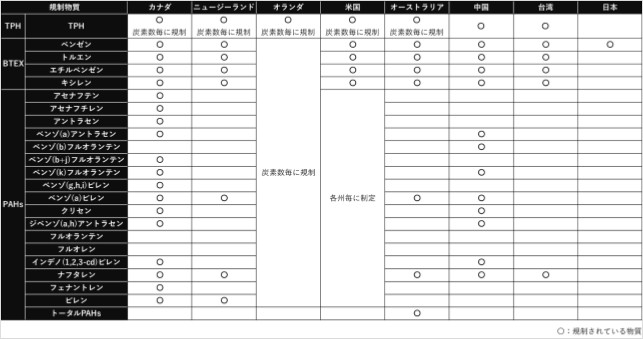
Table 1
In Total Petroleum Hydrocarbons: Environmental Fate, Toxicity, and Remediation, published by Springer, the authors state that "based on the regulatory frameworks of the United States, the United Kingdom, New Zealand, Australia and the Netherlands, it is possible to create new policies and regulatory frameworks for TPH-contaminated sites in developing countries such as China, India, Japan and Korea".(1)
China, however, enacted its Soil Pollution Prevention and Control Law in January 2019 and, as Table 1 shows, has built a regulatory framework that stands comparison with Western countries.
Section 4
4. Cases in China and Kuwait
We have worked with local companies on the remediation of soil, groundwater and marine contamination by petroleum hydrocarbons overseas as well, in China and Taiwan among other places. Here we present enquiries from China and Kuwait as cases.
China
This dates from the time we were considering joint research with the Institute of Agricultural Resources and Environment of the Jilin Academy of Agricultural Sciences.
The black-soil belt of Northeast China is one of the world's three great black-soil regions, blessed with fertile soil rich in organic matter and very well suited to plant growth. Jilin Province lies at the heart of the belt and is an important grain-producing base for China. The belt produces about a quarter of the nation's grain, and to protect the rare natural resource of black soil and secure the nation's food supply, China has set out clearly, in the outline of its 14th Five-Year Plan and 2035 Vision, the implementation of a black-soil protection project for the Northeast, the "giant panda of farmland", and the strengthening of its protection and restoration.
At the same time, China, the world's sixth-largest oil producer, has oilfields such as Daqing, Shengli and Liaohe, with much farmland around them and a great deal of oil-contaminated soil. The Jilin oilfield, though smaller, is no different, and with the development of oil resources the problem of soil contamination has come to the fore. Landed crude, oil sludge and production waste generated in oilfield extraction accumulate, posing a serious threat to the surrounding black soil and seriously affecting the development of sustainable agriculture.
The remediation target set for TPH was 800 (826) mg/kg, a figure taken from the "Soil Pollution Risk Control Standard for Construction Land", while the standard for agricultural land was 500 mg/kg. Remediation targets are decided by risk assessment for human health, ecosystems and so on.
Whereas Japan lists 26 substances for soil contamination, China lists 85; and whereas Japan's analysis is mainly by leaching, China's is by content.
Kuwait
In the Gulf crisis of 1990 to 1991, oil wells were destroyed and enormous damage was done over 114 km2. Crude oil gushed from the damaged wells and formed vast oil lakes.
In 2005 the United Nations Compensation Commission (UNCC) provided funds as guidelines for drawing up a follow-up programme to monitor the technical and financial progress of the environmental remediation works. Under the Kuwait Environmental Remediation Program (KERP), the remediation of an estimated 26 million m3 of oil-contaminated soil was approved by the UNCC.
In 2021, thirty years after the Gulf War, the world's largest remediation project was finally put out to contract: five projects in north and south Kuwait to remediate 13 million m3 of oil-contaminated soil. A further three projects in south Kuwait, to remediate 8.35 million m3 of oil-contaminated soil, are due to be contracted.
Three points deserve particular mention.
- 1. The remediation technology is chosen according to the total petroleum hydrocarbon (TPH) concentration by hexane extraction
1% to ≦5%: bioremediation
5% to ≦7%: bioremediation plus other technologies (soil washing, chemical, solvent extraction, etc.)
7% to ≦10%: other technologies (soil washing, chemical, solvent extraction, etc.)
>10%: no treatment (stabilisation, recovery, reuse, landfill) - 2. It is coupled with a revegetation and ecosystem restoration project
The aim is to transplant native species of shrubs, grasses and trees to the oilfields of north and south Kuwait and return them to their pre-Gulf War state. The species chosen are the most ecologically important and dominate Kuwait's natural ecosystems. Planting runs from September to March each year, with more than 8.6 million plants to be planted over three years. - 3. The remediation target was changed from 5% to TPH 1.0%
The environmental regulator, the Kuwait Environment Public Authority (KEPA), initially set the remediation target criterion (RTC) for oil-contaminated soil at TPH 0.5% as a precaution. Given that the area is oilfield in the desert, it nonetheless carried out a risk assessment considering the effects on human health and ecosystems, and an additional risk assessment of the ecosystems (flora and fauna) present in the oilfields, and arrived at a remediation target of TPH 1.0%. Revising the target to TPH 1.0% cut the volume of soil to be treated by about 1.45 million m3, shortened the remediation period and reduced costs, and left room to adopt additional technologies for reaching the remediation goal more efficiently.
Section 5
5. In closing
Soil does not belong to the landowner alone. It is a shared resource of the whole planet. Soil gives living things water and gives them food. A spoonful of soil, about 1 g, is said to hold some one to ten billion microorganisms, and these microorganisms sustain life on Earth by driving the cycles of the major elements: carbon, nitrogen, phosphorus and others.
Other countries have built legislation aimed at protecting ecosystems just as they protect human health. Should Japan, too, not think seriously about the effects of petroleum hydrocarbons on human health and ecosystems, and commit itself to conserving its ecosystems and its soil?
Reference
Saranya Kuppusamy, Naga Raju Maddela, Mallavarapu Megharaj, Kadiyala Venkateswarlu(2020) Total Petroleum Hydrocarbons:Environmental Fate, Toxicity, and Remediation. Springer
See also
Related pages
Treatment Methods
Soil and groundwater remediation methods
Six remediation methods and how to choose by site conditions.
Testing & Monitoring
Testing and monitoring
From the treatability test to monitoring through completion.
Achievements
Track record
Remediation projects across all 47 prefectures and overseas.